
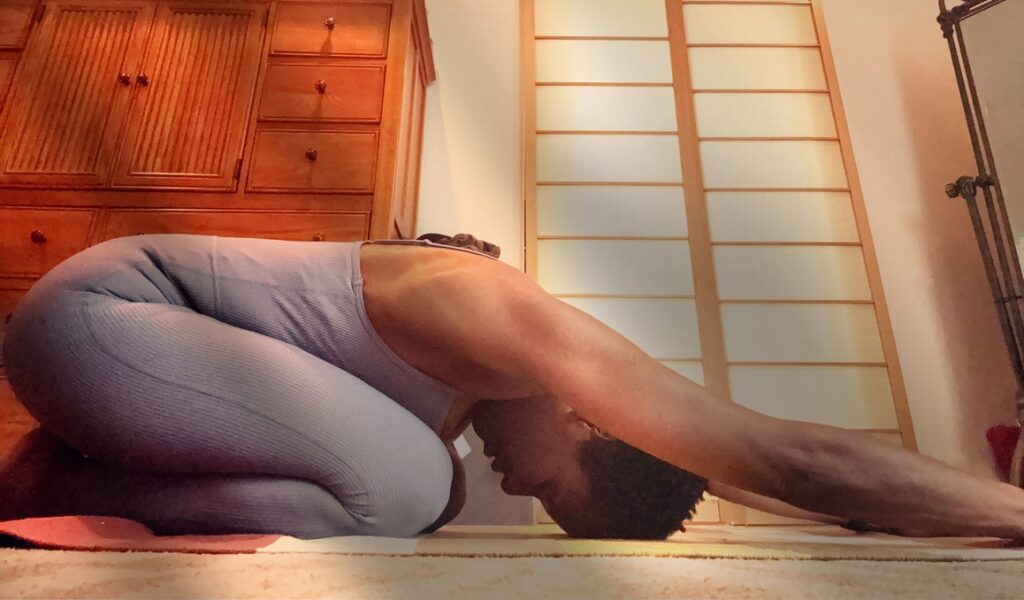
For many, Child’s Pose (Balasana) is a resting position—a passive posture to take at the end of a yoga class. But for me, it’s much more than that, and the benefits of Child’s Pose extend beyond restfulness. Embracing Child’s Pose benefits as the sacred beginning of my practice, I always start in the pose. I do this not to rest, but to awaken inwardly and ground myself before I move. It’s my way of turning down the noise, tuning into my breath, and aligning with the present moment.
Let’s explore why this simple yet powerful pose can transform your yoga flow. It deepens your meditation and sets the tone for a more connected, anti-aging movement ritual.
🧘🏽♀️ Why Child’s Pose Comes First for Me
There’s something profoundly calming and centering about kneeling, folding forward, and surrendering to the mat. Child’s Pose is where I begin every session—not as a pause, but as a purposeful entry into the experience. Experiencing Child’s Pose benefits helps me feel:
- Grounded and supported
- Physically rooted in stillness
- Mentally clear and present
Rather than rushing into movement, I allow my body and mind to arrive. This shift sets the stage for a more mindful, intentional practice.
📏 Physical Attributes of Child’s Pose
Child’s Pose is deceptively simple, yet deeply therapeutic. Discovering Child’s Pose benefits truly reveals how the body is physically aligned in this shape:
- Knees are bent and spread apart (or together, depending on preference), allowing the hips to sink back toward the heels.
- Torso folds forward over the thighs, elongating the spine and gently decompressing the lower back.
- Arms can extend forward with palms down for a subtle stretch through the shoulders, or rest by the sides to completely relax the shoulders.
- Forehead touches the mat, stimulating the vagus nerve and inviting a sense of calm.
- The chest naturally compresses over the abdomen, encouraging deep belly breathing.
This pose gently stretches the back, hips, thighs, and ankles while relaxing the spine, neck, and shoulders. The physical shape mirrors an inward, womb-like retreat, offering a feeling of safety, surrender, and renewal.
🌿 The Meditative Power of Stillness
Child’s Pose creates a bridge between the outer world and the inner self. By adopting this posture at the beginning, I ease into a meditative state of mind before my physical body even begins to move. This dynamic balance of Child’s Pose feels active on the inside. It is as if I’m awakening the breath, awareness, and energy that fuel every pose that follows.
This inward attention has long-term benefits, particularly in terms of anti-aging and stress reduction. Slowing the nervous system, softening tension in the hips and spine, and connecting to breath all support the body’s ability to repair, restore, and glow from within.
✨ Benefits of Beginning Your Practice in Child’s Pose
If you’re used to seeing Balasana as a “break,” consider these Child’s Pose benefits and reasons to start your practice there instead:
🌬️ Activates breath awareness: With your torso compressed gently over your legs, it’s easier to feel and control deep, diaphragmatic breathing.
🧠 Calms the mind: This pose engages the parasympathetic nervous system, reducing stress hormones that contribute to inflammation and premature aging.
🪷 Increases body awareness: You tune in to tightness, fatigue, or openness before moving into more demanding asanas.
🌍 Grounds your energy: The close connection to the earth creates a physical and emotional sense of stability.
🌸 A Small Pose with Big Impact
In a world that’s always telling us to do more, go faster, and sweat harder, Child’s Pose offers something rare: permission to slow down and come home to yourself. Recognizing Child’s Pose benefits, for me, this pose is the foundation of a radiant yoga practice. It is why I return to it every single time I roll out my mat.
If you haven’t already tried beginning your practice this way, I invite you to experience the deep calm, clarity, and connection that comes from starting small—with breath, stillness, and self-awareness.
