

Your skin follows a natural daily rhythm, known as the skin body clock, just as the rest of your body does. During the day, it primarily focuses on protection against sunlight, pollution, and other environmental stressors. At night, its priorities begin to shift toward renewal and repair.
This relationship between time and the skin is sometimes called skin chronobiology. Understanding it does not require a complicated routine or perfectly timed products. It simply invites us to become more intentional about what our skin may need from morning to evening.
For me, skincare has always been about more than appearance. It is a daily ritual of listening and responding. When we work with the body’s natural rhythms rather than continually asking it to do more, beauty becomes a gentler, more intuitive practice.
What Is Skin Chronobiology?

Chronobiology is the study of how natural biological cycles affect the body. The most familiar is the circadian rhythm—the roughly 24-hour internal clock that influences sleep, hormones, body temperature, and many other functions.
The skin also has its own circadian activity. Skin cells contain internal clocks that help coordinate functions such as barrier protection, hydration, inflammation, and cellular renewal. Emerging research suggests these processes may fluctuate throughout the day and night, although scientists are still studying how best to apply this knowledge to skincare.
The practical lesson is simple: your skin does not behave exactly the same way at every hour. Its needs may change as you move through the day.
How Your Skin Changes From Morning to Night

During daylight hours, the skin serves as your first line of defense against ultraviolet radiation, pollution, changing temperatures, and moisture loss. A morning routine should therefore emphasize hydration and protection.
At night, the skin is no longer exposed to direct sunlight or the same level of environmental stress. This creates an opportunity to cleanse away the day and use products that support moisture and renewal.
Some studies have also found that transepidermal water loss—the water that naturally passes through the skin—can vary throughout the day. This may help explain why skin sometimes feels drier, tighter, or more sensitive at night.
These rhythms are not identical for everyone. Age, climate, sleep, stress, medications, skin conditions, and lifestyle can all influence how your skin responds. Think of your body clock as a guide, not a rigid schedule.
A Morning Skincare Routine That Protects
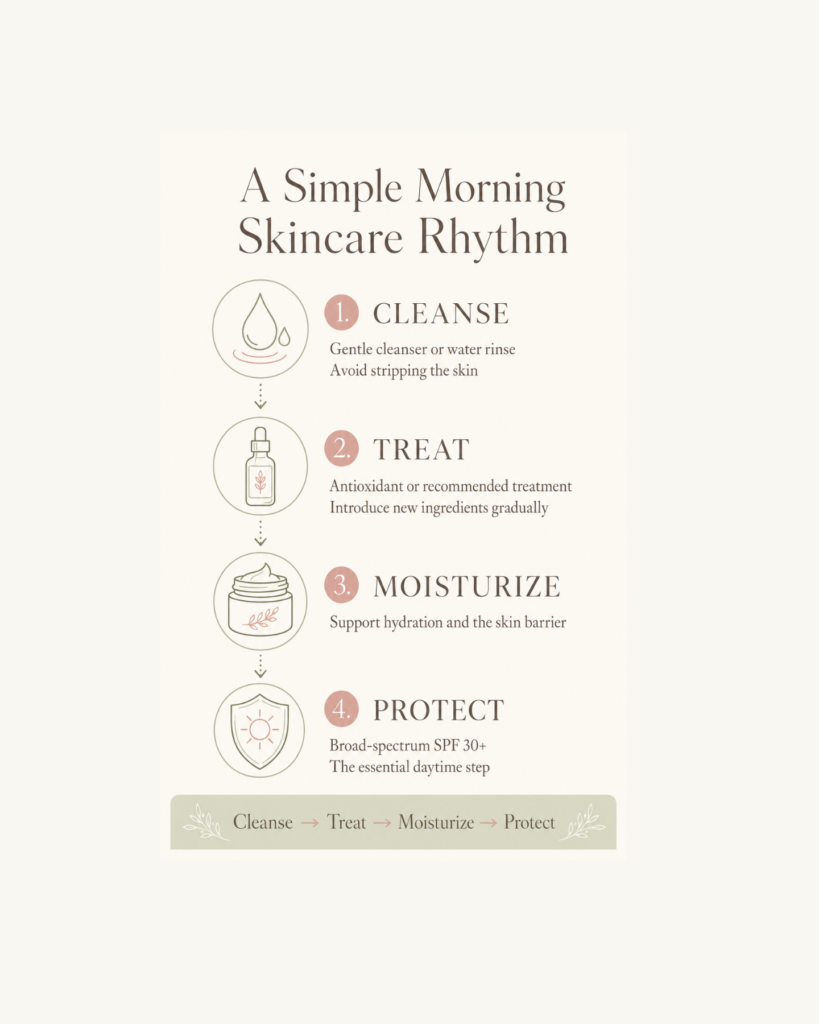
Your morning routine does not need to be elaborate. Its primary purpose is to prepare your skin for the day.
Cleanse gently
Wash with a mild cleanser—or simply rinse with water if that works better for your skin. Over-cleansing can leave dry or sensitive skin feeling stripped.
Add hydration or treatment
Apply any recommended treatment for your skin, then follow with a moisturizer. Antioxidant products, such as vitamin C, are often used in the morning, but introduce new ingredients gradually and watch how your skin responds.
Finish with sunscreen
Sunscreen is the most important protective step in a daytime routine. Choose a broad-spectrum, water-resistant sunscreen with SPF 30 or higher and apply it after your other skincare products.
The American Academy of Dermatology’s sunscreen guidance explains how much to use and when to reapply.
A simple morning rhythm might be:
Cleanse → Treat → Moisturize → Protect
The goal is not to layer as many products as possible. It is to give your skin what it needs to meet the day.
An Evening Routine for Repair and Renewal
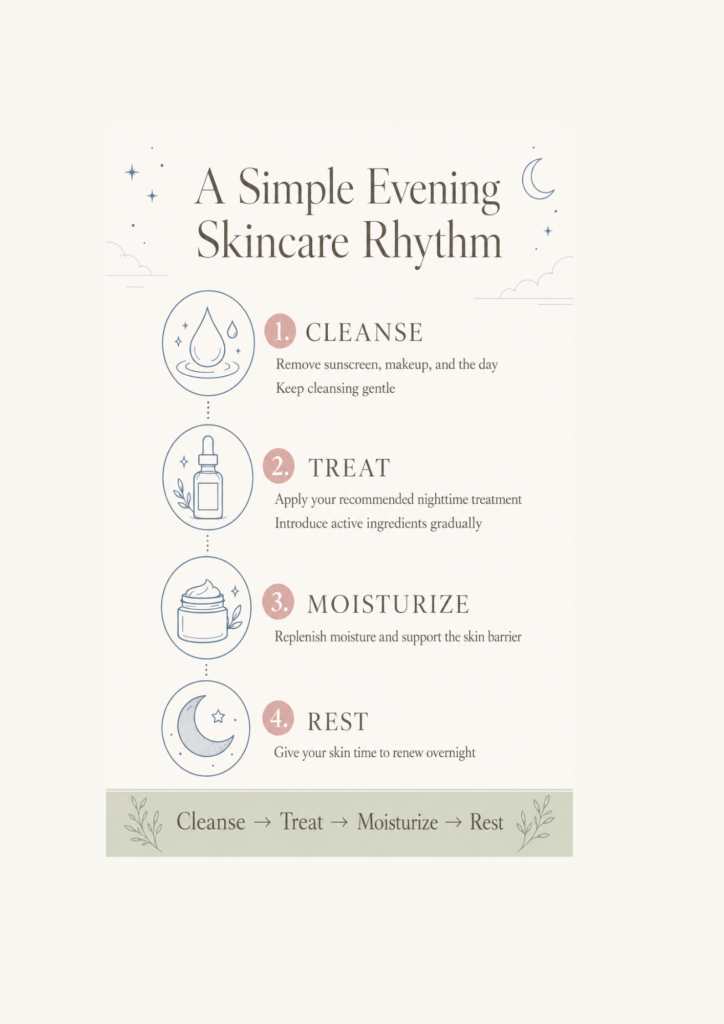
The evening is a natural time to remove sunscreen, makeup, excess oil, and pollutants that have accumulated on the skin.
Cleanse away the day
Use a gentle cleanser and lukewarm water. If you wear makeup or water-resistant sunscreen, you may prefer to remove it first with a cleansing balm or oil and then follow with a mild cleanser.
Apply targeted treatments thoughtfully
Nighttime is often recommended for ingredients such as retinoids because some formulations can be light-sensitive and may increase sun sensitivity. Retinoids are not suitable for everyone, however, and can cause dryness or irritation. Introduce them carefully and consult a dermatologist when appropriate.
Restore moisture
Finish with a moisturizer suited to your skin type. If your skin feels especially dry, look for ingredients that support the skin barrier, such as ceramides, glycerin, or hyaluronic acid.
The recommended product order is generally to cleanse first, apply medication or treatment, and then moisturize. The American Academy of Dermatology’s product-layering guide offers additional guidance.
Your evening rhythm might be:
Cleanse → Treat → Moisturize → Rest
This is also an opportunity to slow down. Rather than rushing through the routine, notice the temperature of the water, the texture of your moisturizer, and the feeling of your hands against your skin. The ritual itself can become a moment of presence.
Sleep, Stress, and Your Skin’s Natural Rhythm

A perfectly timed serum cannot compensate for consistently poor sleep or chronic stress. The body’s systems are connected, and the skin often reflects what is happening beneath the surface.
Sleep supports the body’s normal restorative processes. Stress, meanwhile, can affect inflammation, sensitivity, and the skin barrier. This is where the subject connects with—but does not repeat—my earlier reflections on how the nervous system affects skin aging and how cortisol affects the skin.
Consider supporting your evening rhythm by:
- Keeping a consistent bedtime when possible
- Dimming bright lights before sleep
- Creating a short, calming skincare ritual
- Limiting late-night scrolling
- Practicing a few minutes of slow breathing
- Keeping the bedroom cool, quiet, and comfortable
These small practices help turn skincare into part of a wider ritual of rest.
Listen to Your Skin’s Rhythm

Skin chronobiology is an evolving area of research. Although scientists understand that the skin has circadian rhythms, there is not yet sufficient evidence to assign a precise “best” time of day to every ingredient. Claims that a product must be applied at a specific hour should be viewed with caution.
What we can rely on is a simple rhythm: protect the skin during the day, cleanse and moisturize it at night, and support it with rest, consistency, and sun protection.
Ageless beauty is not created by controlling every hour. It grows from paying attention—honoring your skin’s changing needs and meeting them with care.
