

This year’s trends are less about chasing 12 new steps and more about supporting skin longevity—think barrier-first hydration, targeted peptides, and routines that feel calming and consistent. It’s “anti-aging,” but in a more grounded, prevention-forward language.
If you’re overwhelmed, use this filter: Does this trend help your skin function better over time? If yes, it’s worth trying. And if not, it’s probably just noise.
Trend #1: Milky toners (hydration + barrier support without heaviness)
Milky toners are toner-meets-essence-meets-light lotion. They’re especially popular for dry, sensitive, or mature skin because they’re designed to hydrate and support the barrier rather than “strip and squeak.”
Who it’s for
- Dry or tight-feeling skin
- Sensitive or easily flushed skin
- Anyone doing retinoids/exfoliants who needs a gentler cushion step
How to use it
- After cleansing, apply 1–2 layers with hands (press, don’t rub)
- Follow with serum + moisturizer
- In winter: use it morning and night; in summer: once daily
Simple tip: If you’re trying to calm “mystery irritation,” a milky toner can be your routine’s peacekeeper.
Trend #2: Lip peptide treatments (the “lipification” era continues)
@skincarediaries_xo My lips has never been this moisturized 🥹🤭@SKINTIFIC Official #lipserum #lipcare #skincarediaries_xo ♬ original sound – CHxRyGLOW🫧 | Kbeauty
Lip care has become its own category—beyond basic balm. Many 2026 roundups highlight lip peptide treatments as the “upgrade” for softness, bounce, and smoother lip texture.
What to look for
- Peptides + hydrators (like hyaluronic acid)
- Barrier-friendly textures (not stinging plumpers)
How to use it (my practical approach)
- Apply twice daily
- Add a thicker layer at night, like a lip mask
- Pair with SPF lip balm during the day (especially if you’re outdoors)
Trend #3: Retinol body care (because your neck and hands have opinions too)
In 2026, “body care is the new face care”—especially for the neck, chest, hands, arms, and knees. Retinol body products are repeatedly cited as a significant trend.
Start gently (this matters)
Topical retinoids have real evidence for improving signs of photoaging, but they can irritate—so treat body retinol like you would face retinol: slow and steady.
Beginner schedule
- Week 1–2: 2 nights/week
- Week 3–4: every other night if tolerated
- Always moisturize after
- Wear sunscreen on exposed areas (retinoids can increase sensitivity)
Do not mix strong acids + retinol on the same night if you’re reactive.
Trend #4: Neurocosmetics (skin + stress, in the same conversation)
Neurocosmetics are products designed around the skin–brain axis—the idea that stress and nervous system signaling can influence inflammation, sensitivity, and flare-ups.
This can range from calming textures/sensory experiences to formulas exploring neurocutaneous pathways. The science conversation is growing, and it’s becoming a real category to watch (with varying levels of evidence depending on product claims).
How to try this trend without getting played
- Choose one calming product (serum or moisturizer) and use it consistently
- Pair it with an actual nervous system practice (breath, short Meditation, evening wind-down)
Because here’s the truth: the most potent “neuro” ingredient is often your ritual.
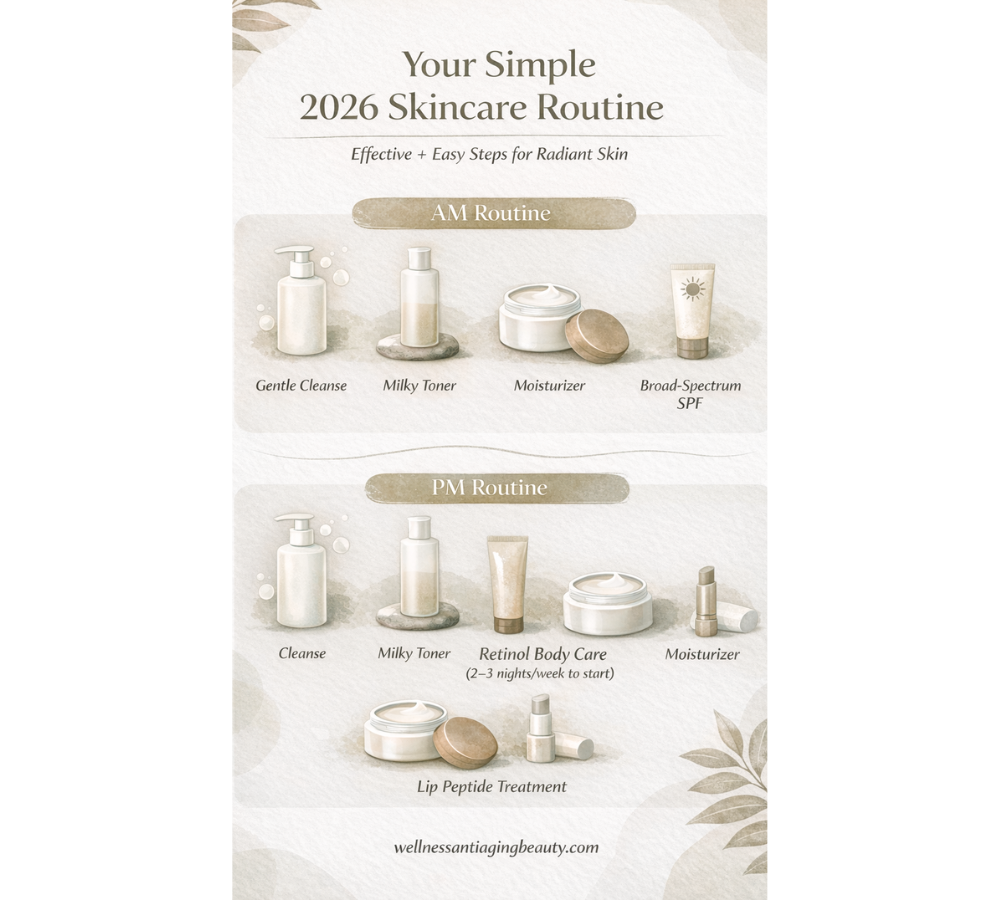
A simple “2026 routine” that doesn’t take over your life
AM
- Gentle cleanse
- Milky toner
- Moisturizer
- Broad-spectrum SPF
PM
- Cleanse
- Milky toner
- Retinol body care (2–3 nights/week to start)
- Moisturizer
- Lip peptide treatment
Make it a ritual: the skin-brightening power of winding down
If you want a beauty ritual that costs nothing, build a 10-minute evening downshift. Dim lights, soften your shoulders, and let your skincare be a cue for calm.
Disclaimer: This article is for educational purposes and doesn’t replace medical advice. If you have eczema, rosacea, or persistent irritation, consider checking with a board-certified dermatologist.
